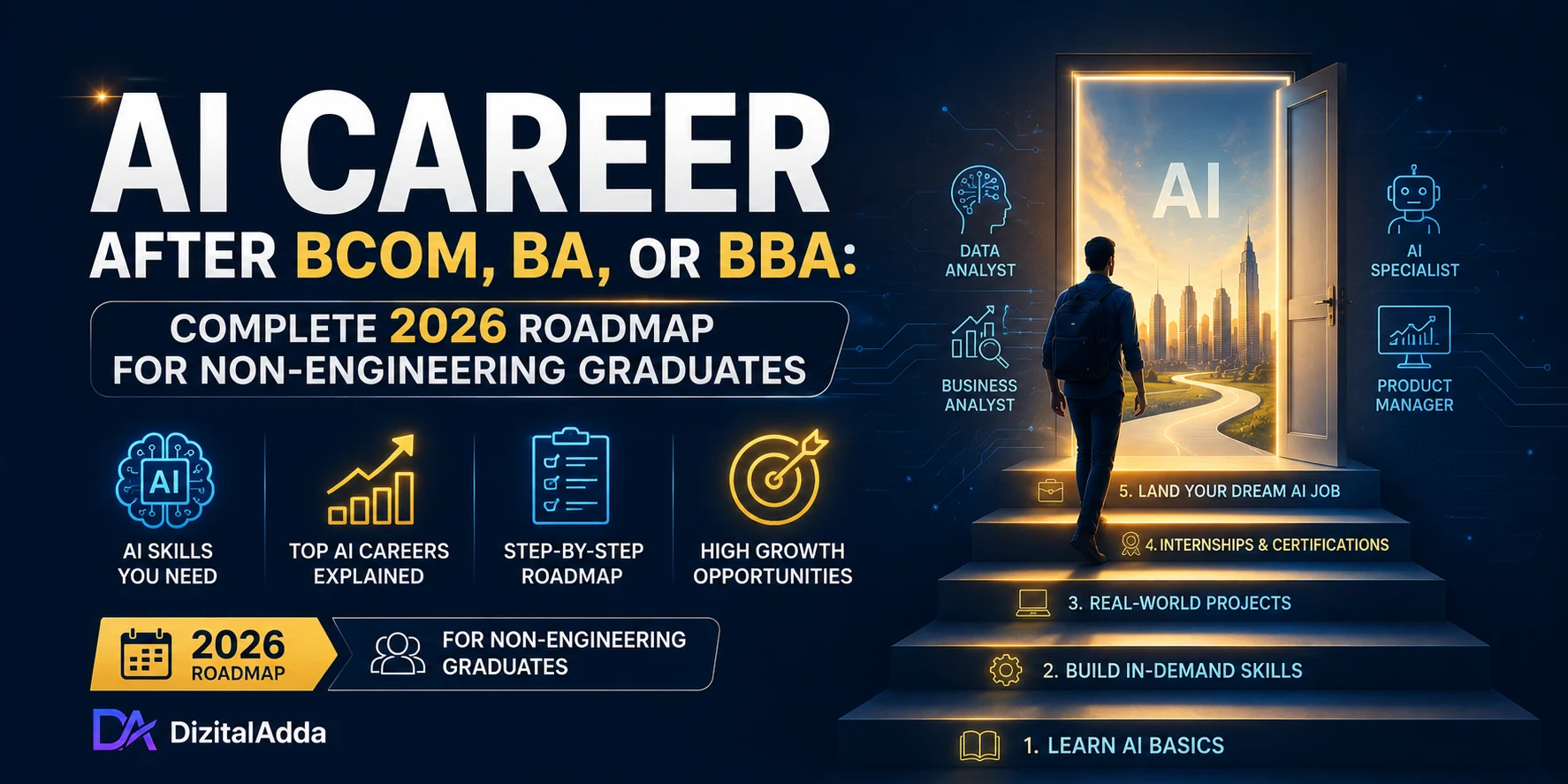
AI Career After BCom, BA, or BBA: Complete 2026 Roadmap for Non-Engineering Graduates
If you graduated in commerce, arts, or business administration and assumed AI careers were reserved for engineers, you've been working off outdated information. Nearly 1 in 4 AI learners in India today come from non-technical backgrounds, and over half of all AI-enabled career outcomes now sit outside traditional engineering roles entirely — spanning leadership, consulting, HR, marketing, and finance.
That's not a niche trend. That's a structural shift in how companies are building AI capability, and it means your BCom, BA, or BBA degree isn't the disadvantage you might think it is.
This guide walks you through exactly which AI roles you can realistically target, what skills you actually need, what these roles pay in India in 2026, and a practical 90-day plan to get your first AI-related role.
Why Your Commerce, Arts, or BBA Degree Isn't a Disadvantage in AI
The assumption that "AI = coding" made sense five years ago, when almost every AI-related job was a machine learning engineering role. That's no longer true.
Modern AI tools — ChatGPT, Claude, Gemini, and the dozens of no-code platforms built on top of them — have moved the bottleneck. Companies don't just need people who can build AI models anymore. They need people who can:
- Write prompts that get reliable, useful output
- Understand a business problem well enough to know where AI actually helps
- Communicate AI capabilities and limitations to non-technical stakeholders
- Review, edit, and quality-check AI-generated work
- Apply AI inside an existing domain — marketing, finance, HR, operations — without needing to touch the underlying model
None of that requires a computer science degree. In fact, your business, communication, or humanities background is often the more relevant qualification for these roles, because the hard part isn't using the AI tool — it's knowing what to ask it and judging whether the answer is good.
The honest caveat: deep technical roles like ML Engineer, AI Research Scientist, or MLOps Engineer do require coding and a strong math foundation. This guide isn't pointing you there. It's pointing you toward the roles where your existing degree is the asset, not Python.
7 AI Career Paths That Don't Require Coding
Here's a realistic breakdown of non-coding AI roles available in India right now, what they actually involve, and who tends to be a good fit.
A few of these deserve more context.
Prompt Engineer is the most talked-about non-coding AI role, and for good reason — it rewards exactly the skills a humanities or communication background builds: precision in language, structured thinking, and iterative refinement. If you want a deeper walkthrough of this specific path, we've covered it in detail in Prompt Engineering for Beginners and How to Become a Prompt Engineer in India.
AI Business Consultant and AI Product Analyst roles are growing fastest among commerce and BBA graduates specifically, because they sit at the intersection of "understands the business" and "understands what AI can and can't do" — neither of which requires writing a single line of code.
The Marketing/HR/Finance + AI hybrid path is often the fastest realistic option if you're already employed. You don't need to switch careers — you need to become the person on your team who knows how to use AI tools well. That alone creates a measurable salary premium and a clear promotion path.
Salary Expectations for Non-Coding AI Roles in India (2026)
Salaries for non-coding AI roles trail pure engineering roles, but the gap is smaller than most people assume — and the growth curve is steep once you have 2–3 years of applied experience.
For context on how this compares to engineering-heavy AI roles — GenAI Engineer, ML Engineer, AI Research Scientist — see our full breakdown in AI Jobs in India Salary 2026. The short version: technical roles have a higher ceiling, but non-coding roles have a faster, lower-friction entry point, and the gap narrows significantly by the 3-year mark for people who specialise.
The Skills You Actually Need (No Python Required)
Skip the temptation to "learn to code first." For the roles above, these four things matter far more:
1. Prompt writing and structured thinking. This is learnable in weeks, not years. It's less like programming and more like writing a very precise brief — the better you are at breaking a problem into clear steps, the better your AI output will be.
2. Basic data literacy — not statistics. You don't need to run a regression. You need to read a dashboard, spot when a number looks wrong, and ask the right follow-up question. This is a vocabulary skill, not a math skill.
3. Fluency in one AI tool stack. Pick a lane and go deep rather than skimming ten tools shallowly. A practical starting stack:
- A general-purpose AI assistant (ChatGPT or Claude) for reasoning and content
- A no-code automation tool (Zapier or Make) for connecting AI into workflows
- One domain-specific AI tool relevant to your target role (Canva AI for content roles, an AI-powered CRM for sales/marketing roles, etc.)
4. Communication and domain translation. This is the skill that's hardest to fake and most valuable in practice — the ability to sit between a technical AI team and a business stakeholder and translate accurately in both directions.
90-Day Roadmap to Your First AI Role
You don't need a year-long course to start. Here's a realistic three-month plan.
Days 1–30: Build Foundations and Tool Fluency
- Spend 30 minutes a day actually using AI tools for real tasks, not just experimenting idly
- Learn the basics of prompt structure: context, instruction, format, constraints
- Pick your domain lane (content, business analysis, marketing, ethics/policy) and start following 3–5 credible sources in that specific niche
- Take one structured course to fill knowledge gaps systematically rather than learning everything piecemeal
Days 31–60: Build Two Portfolio Projects
Certificates alone won't get you hired. A portfolio will. Two project ideas that work well for non-technical AI roles:
- An AI-assisted content calendar or campaign plan for a fictional (or real, if you can get permission) small business
- An automated workflow using a no-code tool that solves one real, specific problem — e.g., auto-summarising customer feedback, or auto-drafting first-pass email responses
Document both clearly: the problem, what you built, and the measurable outcome. This single document does more for your job search than any certificate.
Days 61–90: Apply, Network, and Target the Right Companies
- Update your LinkedIn headline and summary to reflect your specific AI specialisation, not a generic "AI enthusiast" label
- Apply to roles explicitly, not just AI-titled roles — many non-coding AI jobs are listed under marketing, business analyst, or operations with "AI tools experience preferred"
- Target growth-stage startups and mid-size companies first; they adopt AI tools faster than large enterprises and are more willing to hire for potential over pedigree
- Join 2–3 active LinkedIn or community groups in your specific niche and contribute genuinely before asking for referrals
Which Course Should You Pick?
If you want structured learning rather than piecing it together yourself, look for a course that's built around practical projects, not just theory. A few signs of a well-structured non-coding AI course:
- It includes hands-on work with real prompting and AI tools, not just slides on "what is AI"
- It's specific to a track (GenAI/prompt engineering, or data analytics) rather than a vague "AI for everyone" course
- It results in a portfolio piece you can show employers, not just a certificate
DizitalAdda's Diploma in GenAI and Prompt Engineering and Diploma in Data Analytics & AI are both built around this practical, project-first approach if you're looking for a structured path rather than self-teaching from scratch.
Common Mistakes Non-Tech Graduates Make
Comparing yourself to CS graduates. You're not competing for the same roles, and trying to out-code an engineering graduate is a losing game. Compete on the skills that are actually scarce: business judgment, communication, and domain expertise paired with AI fluency.
Collecting certificates without building anything. A stack of completion certificates with no portfolio signals that you've watched videos, not that you can do the work. One real project beats five certificates.
Ignoring your existing domain knowledge. If you have two years of marketing or finance experience, don't discard it to "start fresh in AI." Combining domain expertise with AI skills is far more valuable — and far less crowded — than competing as a generic AI generalist.
Waiting for the "perfect" course before starting. The 90-day roadmap above works whether or not you're enrolled in anything formal. Tool fluency and a portfolio project can start this week.
Frequently Asked Questions
Can a commerce graduate become an AI professional?
Yes. Commerce graduates are well-suited to roles like AI Business Consultant, AI Product Analyst, and AI-driven finance or marketing roles, where business understanding matters more than coding ability. Many non-coding AI roles in India today are filled by exactly this background.
Is coding compulsory for AI jobs in India?
No, not for all AI jobs. Coding is required for technical roles like ML Engineer or AI Research Scientist, but roles like Prompt Engineer, AI Content Specialist, AI Product Analyst, and AI Business Consultant don't require programming skills.
Which AI job is best for BBA graduates?
AI Product Analyst and AI Business Consultant roles tend to fit BBA graduates well, since both rely on understanding business operations and translating them into AI-ready workflows — skills a business degree directly builds.
How long does it take to start an AI career without coding?
With focused effort, 90 days is enough to build tool fluency, complete 1–2 portfolio projects, and start applying. Landing your first role typically takes another 1–3 months on top of that, depending on your target companies and how targeted your applications are.
What is the salary for non-coding AI jobs in India in 2026?
Fresher salaries for non-coding AI roles in India range from roughly ₹4–14 LPA depending on the specific role and company tier, rising to ₹12–22 LPA at the 2–4 year mark with domain specialisation, and ₹20–35 LPA for senior, strategy-level roles.
Key Takeaways
- Nearly 1 in 4 AI learners in India come from non-technical backgrounds — your degree isn't a disadvantage
- Roles like Prompt Engineer, AI Content Specialist, AI Product Analyst, and AI Business Consultant don't require coding
- Prompt writing, basic data literacy, AI tool fluency, and communication matter more than Python for these roles
- A focused 90-day plan — tool fluency, two portfolio projects, targeted applications — can realistically get you to your first AI role
- Combining your existing domain knowledge (finance, marketing, HR) with AI skills is more valuable than competing as a generic AI generalist
About the Author
Sapna
Sapna is a Content Writer and Digital Marketing Specialist at DizitalAdda with over 3 years of experience in SEO, content strategy, and writing about AI tools and emerging search trends. She covers topics across digital marketing, search engine optimisation, generative AI, and career guidance for students and professionals looking to build a future in the digital space. Based in New Delhi.